By Lauren | Salt Lake Occupational Therapy
Last updated: October 16, 2026
If your child is heading to preschool or kindergarten and you’re wondering whether they’re “ready,” occupational therapy (OT) can help build the real-life skills that make school days go more smoothly—like following routines, sitting for circle time, handling pencils and scissors, self-care, and coping with noise or transitions. Families can expect playful, strengths-based sessions and practical home strategies tailored to your child. OT does not is not a substitute for individualized medical care or may support specific outcomes, and every plan is individualized. If you’re in Salt Lake City and want guidance on next steps, we can help you explore options and decide whether OT is a good fit.
What “school readiness” really means
School readiness is more than knowing the alphabet. It includes the developmental foundations that allow children to participate in learning and play with peers: attention and regulation, fine and gross motor skills, independence in self-care, communication, and the ability to move between activities. Pediatric organizations emphasize that readiness is a whole-child concept, not a checklist of academics (AOTA).
For ages 3–5, many families look to developmental milestones to understand what’s typical. The Centers for Disease Control and Prevention offers milestone checklists and guidance on what to do if you have concerns (CDC developmental milestones). Remember that milestones are guides, not pass/fail tests. Children grow at different rates, and support can help them participate more fully.
How occupational therapy supports school readiness
OT focuses on helping children do the everyday “jobs” of childhood—playing, learning, and caring for themselves—by developing underlying skills and adapting tasks or environments.
Self-regulation and attention
- What this looks like: Settling into circle time, waiting a turn, recovering after a disappointment, and staying engaged with a short activity.
- How OT may help: We use playful sensory-motor activities and co-regulation strategies to help children learn how their bodies feel when they’re “just right” for learning. We also suggest classroom and home supports—like movement breaks, visual schedules, or a quieter spot for transitions. Sensory processing differences can affect participation, and targeted strategies may improve comfort and focus (STAR Institute for Sensory Processing).
Fine motor and pre-writing
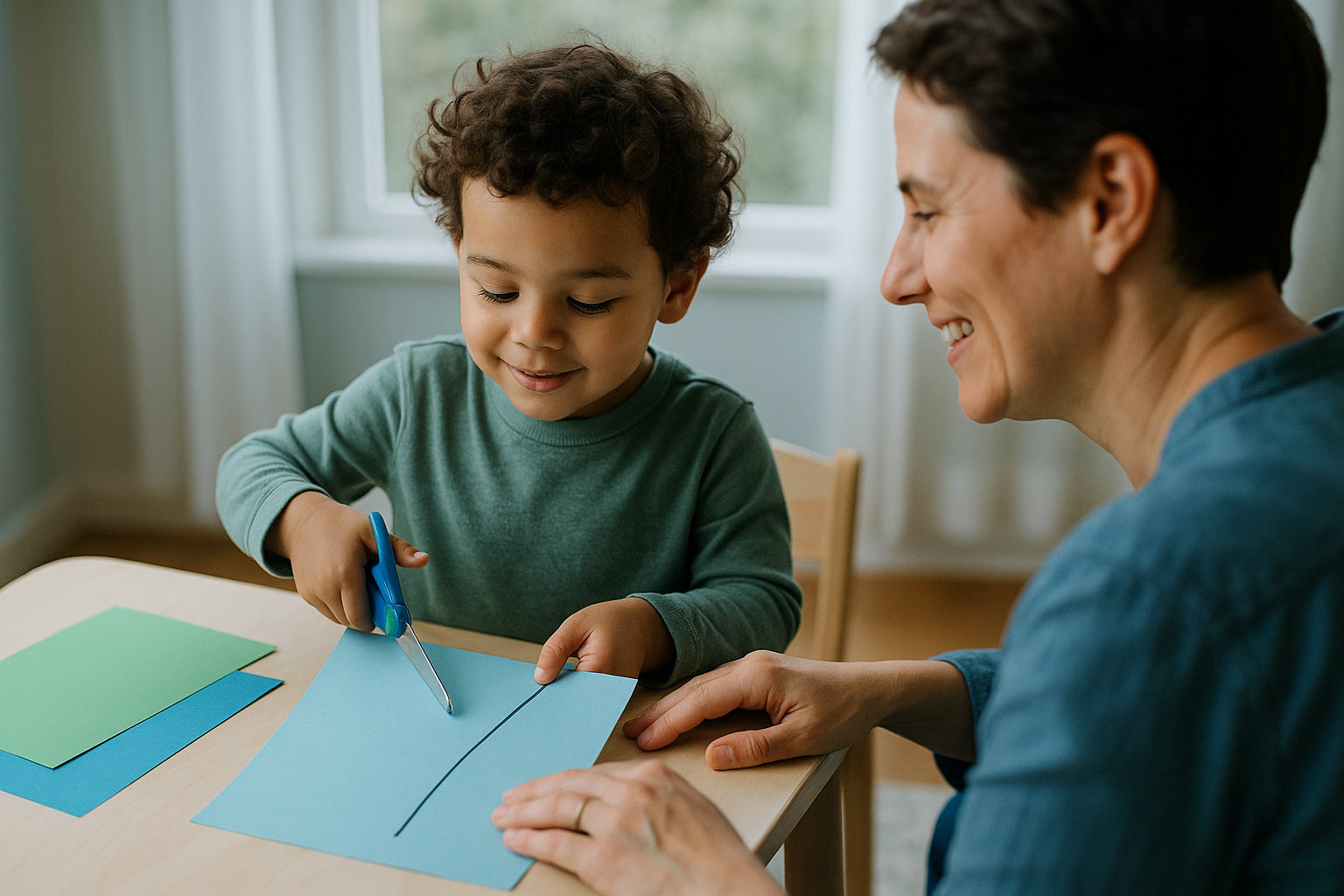
- What this looks like: Using a functional pencil grasp, snipping with child-safe scissors, manipulating preschool tools, and starting to draw simple shapes.
- How OT may help: We strengthen hand and shoulder stability through play, build dexterity with toys and everyday items, and introduce developmentally appropriate pre-writing strokes before letters. We also help right-size expectations—pencil grasp and handwriting emerge over time, and kids benefit from playful practice rather than pressure. For more detail on early writing foundations, you might find our article on building pre-writing skills helpful: Boost Writing Readiness in Preschoolers.
Sensory processing and participation
- What this looks like: Coping with the sounds of a busy classroom, different textures (like glue or paint), sitting on the rug, and navigating playground equipment.
- How OT may help: We identify sensory preferences and sensitivities, then co-create routines that support participation—such as movement opportunities before seated tasks, alternative seating, or gradual exposure to tricky textures. When needed, we collaborate with caregivers and teachers to adjust environments so the child can engage more comfortably (STAR Institute for Sensory Processing).
Independence in daily routines
- What this looks like: Managing zippers and buttons, opening snack containers, washing hands, and following multi-step routines like arrival/pack-up.
- How OT may help: We break tasks into manageable steps, use visuals, and practice in context. Small successes—like zipping a jacket or cleaning up after an activity—build confidence and reduce morning and classroom stress.
Gross motor and playground confidence
- What this looks like: Body awareness, balance, navigating lines and stairs, and starting and stopping safely during games.
- How OT may help: We build core strength and coordination through whole-body play, obstacle courses, and motor planning games. Improved body control can make sitting easier and recess more fun.
When to consider OT—and what you can expect in SLC
Consider an OT consult if your child:
- Struggles to settle for short seated activities or needs frequent movement to participate
- Has big reactions to everyday sensations (noise, touch, clothing, or messy play)
- Avoids or tires quickly with drawing, snipping, or bead/threading activities
- Finds transitions especially hard, even with warnings
- Needs extra help with dressing, opening containers, utensil use, or handwashing
- Seems unsure on playground equipment, stairs, or in line
In Salt Lake City, occupational therapy is available through private practices and community-based providers. At Salt Lake Occupational Therapy, we support families in the Salt Lake City area with individualized, play-based care and parent education. To learn how we approach regulation—a key pillar of school readiness—see our page on regulation support services.
Here’s what a typical process may look like:
- Conversation about your goals and daily routines, plus a screening or evaluation of functional strengths and barriers
- Collaborative goal-setting that reflects your child’s interests and school expectations
- Playful sessions (clinic, community, or home-based) paired with simple home strategies to weave into your day
- Communication with your child’s care team—teachers, therapists, and pediatric providers—when you consent, so everyone is rowing in the same direction
If your child has safety concerns (e.g., elopement or severe self-injury), contact your pediatrician promptly or seek urgent care. Safety comes first.
Practical tips you can try at home this week
- Make transitions predictable: Use a short visual schedule with 3–4 pictures. Offer a 2-minute warning and a playful “race” to the next activity.
- Right-size seated time: Alternate 5–10 minutes of a tabletop activity with a quick movement break (animal walks to the sink, a wiggle song, or carrying books).
- Build hand strength through play: Play with playdough, tongs, clothespins, spray bottles, and vertical surfaces (draw on an easel or tape paper to a wall).
- Offer sensory options: A small fidget, a sit disc, or a spot at the end of the rug can make group time feel more comfortable.
- Practice self-care in context: Before heading out, add one “practice” step (e.g., you start the zipper, your child finishes). Celebrate effort over perfection.
For families who like checklists, the CDC’s milestone resources include practical “Learn the Signs. Act Early.” tips you can use at home (CDC developmental milestones). And if you’re curious about how OT’s scope covers these areas, the American Occupational Therapy Association outlines how OTs support participation in school and community settings (AOTA).
Getting started in Salt Lake City
If you’re unsure whether to pursue an evaluation, a brief conversation can clarify options and timing. You can request a consultation in Salt Lake City to talk through your child’s strengths, the school context, and your priorities for the coming months. If OT is a good fit, we’ll outline an individualized plan. If another path makes more sense, we’ll share resources and referrals. If you live outside Salt Lake City, we may be able to suggest Utah-based options to explore closer to home.
Editorial note
This article is educational and is not medical advice. It does not diagnose or treat any condition. Please consult your pediatrician or a licensed clinician who knows your child for personalized guidance.
References
- Developmental Milestones (Learn the Signs. Act Early.). Centers for Disease Control and Prevention (CDC). Accessed 2026. https://www.cdc.gov/ncbddd/actearly
- Occupational Therapy and Children & Youth: Promoting Participation in School and Community. American Occupational Therapy Association (AOTA). Accessed 2026. https://www.aota.org
- What Is Sensory Processing Disorder (SPD)? STAR Institute for Sensory Processing. Accessed 2026. https://www.spdstar.org
Families can also learn about our home and school occupational therapy sessions when that approach fits their goals.
For a related perspective, read Does My Child Need Pediatric Occupational Therapy? Utah Guide.
How we can help: Home & School Sessions
Flexible care that meets you where you are, addressing challenges in your child's natural environment.
Learn about our Home & School SessionsReady to support your child?
Book a free 20-minute consultation with Lauren to see if SLOT is the right fit.
Book a Free Call