By Lauren | Salt Lake Occupational Therapy
Last updated: October 5, 2026
Community-based occupational therapy may be a fit if your child does well in the clinic but struggles in everyday places like the playground, grocery store, or library. In this approach, sessions happen where life happens, so skills can transfer into real routines. Families can expect coaching, practice with real tasks, and simple strategies tailored to your child and context. Not every goal is appropriate for every setting, and safety always comes first. If you’re curious whether this model matches your needs in Salt Lake City, a brief consultation is a helpful next step.
What is community-based occupational therapy?
Community-based occupational therapy brings services into real-life environments—homes, parks, stores, libraries, and other places where children participate. The focus of OT is supporting participation in meaningful daily activities, not just isolated exercises, which aligns well with working in natural contexts (American Occupational Therapy Association). When we practice a skill exactly where it’s needed, children and caregivers see how strategies fit into their day.
Why “natural environments” matter
Children learn best through play and practice that feel relevant. Natural-environment sessions can help with sensory regulation, motor planning, self-care, and social participation in the moment they’re needed. For example, navigating a busy playground offers authentic chances to work on balance, turn-taking, and frustration tolerance. Families can also monitor developmental skills with trusted guides like the CDC’s milestone resources to inform goals and track progress over time (CDC Act Early).
Benefits for young children and families
Community-based OT can complement clinic sessions or, for some families, serve as the primary model. Here are benefits families in Salt Lake City often appreciate:
- Realistic practice and carryover: Skills are rehearsed where they’ll be used, which may support generalization to daily life.
- Parent and caregiver confidence: Coaching offers practical strategies you can apply between sessions.
- Sensory-informed supports: The actual sights, sounds, and movement of a setting can be adjusted to fit your child’s sensory profile (STAR Institute for Sensory Processing).
- Family-centered care: Goals align with your priorities and routines so progress feels meaningful at home and in the community (American Academy of Pediatrics).
How skills may generalize across settings
Generalization—using a skill in new places—can be challenging for young children. Practicing a two-step direction in the clinic may not automatically translate to following directions in a noisy store. In community-based OT, we purposefully change the task or environment in small ways (lighting, noise, distance, visual supports) so your child can apply the same skill with growing independence.
What a community session may look like in SLC
Every plan is individualized. Here are examples of what sessions can look like around Salt Lake City:
At home: daily routines
- Morning routine: Using a simple visual schedule, practicing dressing with adapted fasteners, and building a calm “first-then” plan to ease transitions.
- Feeding: Adjusting seating and utensils, exploring textures, and setting up a predictable mealtime routine that supports regulation.
Neighborhood playground
- Climbing and balance: Graded challenges on steps and slides for motor planning and core stability.
- Social participation: Practicing turn-taking scripts, body-space awareness, and coping strategies for waiting.
Grocery store
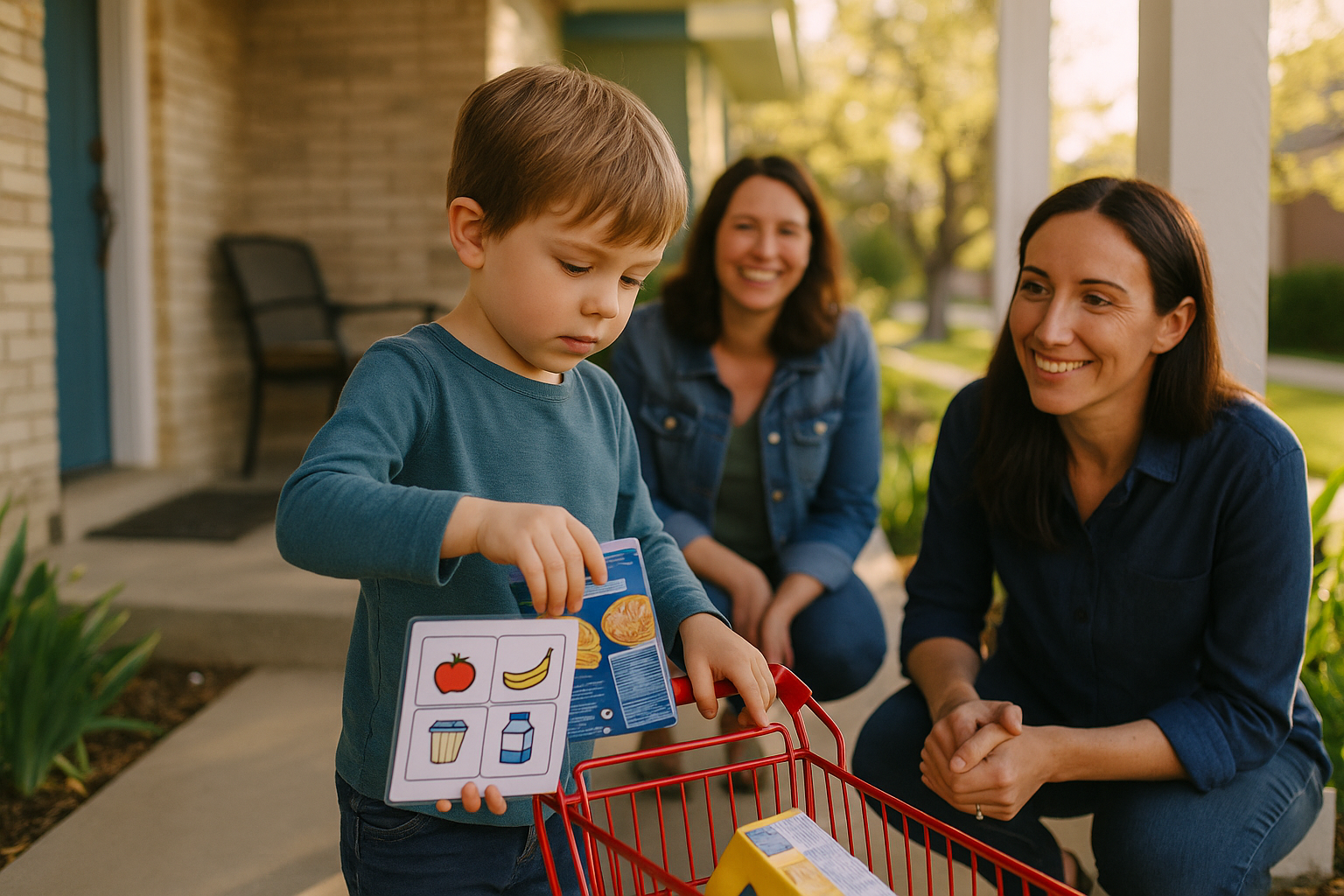
- Planning and sequencing: Working from a picture list, pushing a cart safely, and choosing one “just-right” snack.
- Sensory supports: Using ear protection, movement breaks, or a designated “quiet aisle” plan if needed.
Library or community event
- Self-regulation: Identifying a calm corner, using visual timers, and practicing whisper voice with a simple cue.
- Executive skills: Returning books, following a short route, and packing a backpack with needed items.
In each example, the therapist coaches caregivers in-the-moment—what to notice, how to prompt, when to fade help—so you can repeat strategies confidently on your own.
Is community-based OT right for your child?
Community-based OT may be a good fit if:
- Your child uses skills in therapy but has trouble using them in daily routines.
- You want hands-on caregiver coaching during the tasks that matter most.
- Environmental factors (noise, movement, crowds) strongly influence your child’s participation.
It may be less suitable when:
- Goals require specialized equipment best used in-clinic.
- A setting is currently too overwhelming to be safe, and your child needs gradual preparation first.
- There are immediate safety concerns (for example, elopement near roads); in these cases, seek timely professional guidance. If there is an urgent risk of harm, contact local emergency services.
What to expect from a plan
- Collaborative goal-setting: We align therapy targets with family priorities and routines.
- Gentle scaffolding: We break tasks into small steps, add visual or sensory supports, and gradually reduce help as your child gains confidence.
- Data in the wild: We track progress based on participation—duration of calm play, number of successful transitions, or the steps your child completes independently—instead of only clinic-based measures.
How we support families in Salt Lake City and Utah
Salt Lake Occupational Therapy primarily serves families in Salt Lake City. Depending on scheduling and clinical needs, limited community-based sessions may be available in nearby areas; availability outside SLC is considered case by case. Many Utah families also meet at common community locations around the city.
If you’re seeking strong caregiver coaching woven into everyday routines, explore our approach to parent coaching in occupational therapy. When sensory regulation is a key focus, we can incorporate strategies grounded in sensory processing principles alongside play-based practice in natural environments. For families ready to explore options or ask questions about fit, you can request a consultation to discuss your child’s needs and next steps.
Frequently asked questions
Will community-based OT replace clinic sessions?
Not necessarily. Many children benefit from a blend: targeted clinic work for specific skills, plus community sessions for carryover. The plan depends on your child’s goals and your family’s routines.
How are goals chosen?
We collaborate to identify high-impact moments—mornings, mealtimes, transitions, outings—and set functional goals tied to participation. Guidance from pediatric organizations underscores keeping care family-centered and routine-based (American Academy of Pediatrics).
What if my child has sensory processing differences?
Community sessions allow us to observe what helps your child feel safe and engaged—movement, deep pressure, quieter corners—and to build those supports into real places like parks and stores (STAR Institute for Sensory Processing).
How do we track development?
You and your therapist may use simple checklists and observations, alongside reputable milestone tools such as the CDC’s materials, to inform intervention and celebrate growth (CDC Act Early).
Editorial note
This article is educational and not medical advice. It does not diagnose conditions or replace guidance from your child’s healthcare providers. If you have urgent safety concerns, seek immediate professional help.
References
- What Is Occupational Therapy? American Occupational Therapy Association (AOTA). Accessed 2026. https://www.aota.org
- Learn the Signs. Act Early. Centers for Disease Control and Prevention (CDC). Accessed 2026. https://www.cdc.gov/ncbddd/actearly
- About Sensory Processing and SPD. STAR Institute for Sensory Processing. Accessed 2026. https://www.spdstar.org
- Family-Centered Care (policy and resources). American Academy of Pediatrics (AAP). Accessed 2026. https://www.aap.org
Ready to see if community-based OT is a match for your family? We’d love to learn about your child, your goals, and the places you want participation to shine. Reach out to schedule a consultation, and let’s design next steps that fit your life in Salt Lake City.
Families can also learn about our home and school occupational therapy sessions when that approach fits their goals.
For a related perspective, read SPD vs ADHD in Children: Real-Life Clues Parents Can Use.
How we can help: Home & School Sessions
Flexible care that meets you where you are, addressing challenges in your child's natural environment.
Learn about our Home & School SessionsReady to support your child?
Book a free 20-minute consultation with Lauren to see if SLOT is the right fit.
Book a Free Call